

Published monthly subscriptions run from $1,099 for one campaign to $10,499 for twenty URL or keyword allocations. Those prices buy recurring campaign capacity, not a guaranteed number of customers or durable ranking improvements.
The popular advice to buy more clicks once a page starts moving skips the important questions: whether the page qualifies, whether the traffic represents independent demand, and whether the campaign's purpose creates Google spam-policy exposure. A lower price per allocation can make a subscription look efficient while the buyer pays for activity that never becomes revenue.
Table of Contents
- Monthly Subscription Prices for Organic Traffic Campaigns
- Sites and Keywords That Qualify for a Campaign
- How Volume Targeting and Support Set the Price
- What a Purchased Click Actually Buys
- Clicks Sessions and Sales Are Different Outcomes
- What a Campaign Looks Like by Business Type
- Growing Clicks Without Buying Them
- Google Spam Risk and the Go or No-Go Decision
Monthly Subscription Prices for Organic Traffic Campaigns
Monthly organic traffic subscription prices
| Plan | Monthly price | Allocations | Approx. price per allocation |
|---|---|---|---|
| Monthly Plan | $1,099 | 1 ongoing campaign | $1,099 |
| Monthly 5x URLs/Keywords | $3,999 | 5 URLs or keywords | $800 |
| Monthly 10x URLs/Keywords | $6,999 | 10 URLs or keywords | $700 |
| Monthly 20x URLs/Keywords | $10,499 | 20 URLs or keywords | $525 |
The useful comparison is monthly price divided by allocated URLs or keywords, rounded to the nearest dollar. This isn't a published cost-per-click schedule: each row reserves campaign capacity rather than promising a fixed visit count.
Our Monthly Plan includes ongoing boosts intended to strengthen the site's behavioral SEO score. The larger subscriptions distribute campaign capacity across more target URLs or keywords, with ranking improvement as the intended outcome. Neither description establishes what an incremental customer will cost.
Read the allocation before the discount
The bundle discount matters only when you can use the bundle. Unused monthly allocations expire, so a five-slot subscription assigned to only two eligible URLs still costs $3,999.
That creates a different purchasing problem from an advertising budget you can concentrate on the best-performing campaign. Before selecting a row, make a roster of eligible targets and decide which URL-keyword combinations deserve recurring attention. Don't count unfinished landing pages or keywords you merely hope to rank for.
For an agency, a slot should have a named client, target page, tracking keyword, and reporting owner. Otherwise, the apparent discount can become unused capacity hidden inside a consolidated invoice.
Budget rule: Compare the price per usable allocation, not just the price per included allocation.
Separate subscriptions from shorter tests
Our seven-day and fourteen-day boosts are shorter tests. First-order pilot prices on the services page can differ from recurring figures, so the table above describes monthly subscriptions, not introductory trials.
Coverage is described as more than twelve countries and every US state. Geography determines where campaign activity is directed and how you assign slots; it doesn't introduce a separate country-price column in this comparison.
Keep this expense separate from technical SEO, content production, and conversion work. Baikou's guide to planning your SEO budget is useful for organizing those broader commitments before adding a recurring engagement subscription. For comparisons between traffic-service models, our SerpClix review and alternatives guide provides another purchasing reference, but compare deliverables rather than assuming every service sells equivalent capacity.
Choose the smallest row that covers eligible URLs already indexed on Google results pages one through three. Use our free CTR audit before subscribing, rather than purchasing spare slots on the assumption that more targets will qualify later.
Sites and Keywords That Qualify for a Campaign
The first gate is an indexed keyword on Google results pages one through three. Our service requires an established website with technical optimization, existing backlinks, and baseline on-page SEO. Campaign capacity isn't a substitute for those foundations.
A search participant needs a listing to find. If the target page isn't indexed, or the keyword sits deeper than the practical campaign window, paying for an allocation doesn't solve the underlying visibility problem.
Build a target sheet before buying
Start with a simple worksheet containing the page URL, its main query, related queries, and current search appearance. Verify the target in the intended location rather than relying solely on a search performed from your own office.
Our starting inputs are:
- Target page URL: Supply the exact destination, not just the domain.
- Main tracking keyword: Choose the query whose performance you want to evaluate.
- Relevant keywords: Add closely related searches that match the same page and intent.
Sharing Google Search Console access, or clicks and impressions data, is optional. We use it to tune optimization; access permission isn't what makes a page indexed or eligible.
For local companies, our stated suitability window is a website ranking on Google pages one or two. National companies use the same window, although heavier competition can make national campaigns take longer. The broader pages-one-through-three requirement is therefore a screening boundary, not a claim that every page inside it is equally promising.
Reject targets that need foundational work
A new domain with no baseline, a keyword that has never appeared in search results, and an unindexed service page fail the practical test. Put those targets into technical, content, and authority work before assigning paid engagement capacity.
A Google Maps or Local Pack objective also needs a different scope. Maps optimization is a separate package, not an alternative way to spend a core organic-search slot.
A page can be commercially valuable and still be the wrong page for this subscription today.
Campaigns are an add-on to content, links, and technical work. List only URLs that already appear within the qualifying search window, then match that usable count to a plan. Don't buy allocations for listings participants can't find.
How Volume Targeting and Support Set the Price
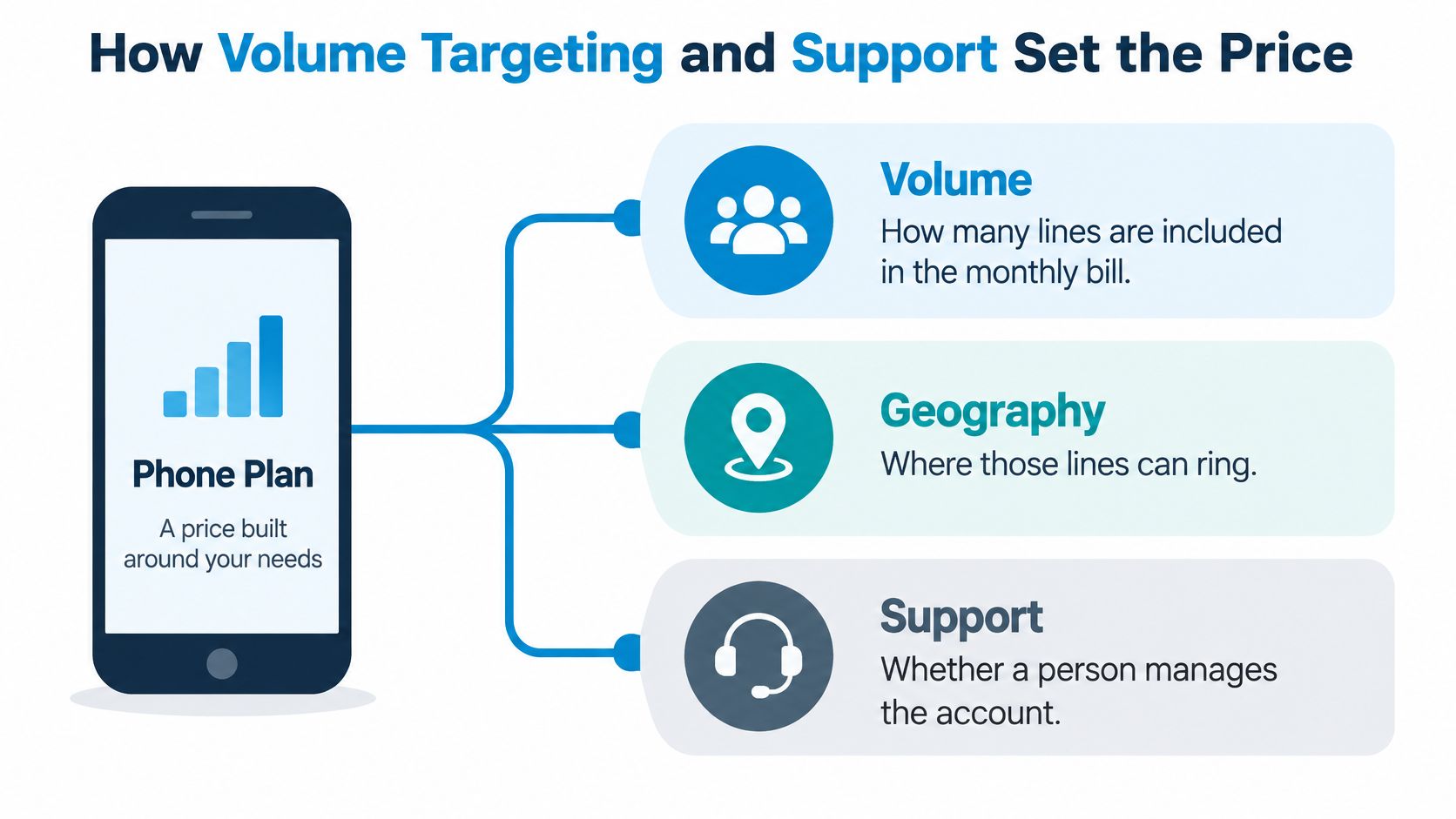
Read the monthly bill like a phone plan. Volume determines how many lines you have, geography determines where those lines can ring, and support determines whether someone manages the account.
Volume sets the bundle economics
Allocation count is the clearest published price lever. Larger plans reduce the listed cost per included allocation, but that doesn't establish that a keyword needs more clicks or that every client needs a campaign.
We advise starting with starter packages and will tell customers if their keywords need higher CTR volume. That distinction matters: more allocations and more activity for a keyword aren't interchangeable purchases.
An agency can distribute a multi-allocation subscription across client URLs and keywords. But consolidating clients into a bigger plan is sensible only after each target has passed screening and has a reporting plan.
A useful allocation worksheet should identify:
- Usable targets: URLs and keywords that qualify now.
- Campaign purpose: The commercial outcome each target supports.
- Measurement owner: The person responsible for deciding whether continued spending is justified.
Geography affects the assignment, not a separate tariff
Local and national targeting draw on the described geographic coverage rather than a separately published country fee. The financial difference is partly timing: a competitive national query can require longer observation before the outcome is readable.
That doesn't mean national targeting automatically deserves a larger package. It means the buyer needs enough budget discipline to distinguish a delayed result from an unsuccessful campaign, without adding targets just to make the subscription feel productive.
Support and Maps require separate decisions
Our 14 Day Boost+ and Monthly Plan+ include higher CTR volume and a dedicated account manager. Higher-volume plans include that management support, so buyers should distinguish paying for capacity from paying for coordination.
A manager may help an agency organize several targets, but account management doesn't replace commercial measurement. Before choosing that tier, identify the work the manager will own and the decision the reporting must support.
Specialized Local SEO and Google Maps optimization can be combined with the monthly plan as an additional service. Don't assume that work is included in the base organic price.
The expensive mistake is paying for more slots, broader targeting, or managed support before starter activity has shown that the selected keyword is a useful place to invest.
What a Purchased Click Actually Buys
Search demand is like a stadium crowd: the stands can be full while fewer people pass through your turnstile. Google can satisfy a search with an answer, map, video, advertisement, or summary before someone considers visiting your website.
According to Statista's search-engine overview, Google held more than 90% of worldwide search-engine market share across devices in 2025, while its 2024 search-and-YouTube advertising revenue exceeded $234.23 billion. A Google-focused campaign is consequently a concentrated platform investment, not ownership of an audience.
In the first quarter of 2019, approximately 41.45% of U.S. Google searches produced an organic click to a non-Google website, according to the Search Engine Land clickstream analysis. The Statista overview also reports that U.S. zero-click searches reached 58.5% in 2024. These are different datasets and methodologies, not a clean time series.
Buy activity without confusing the outcomes
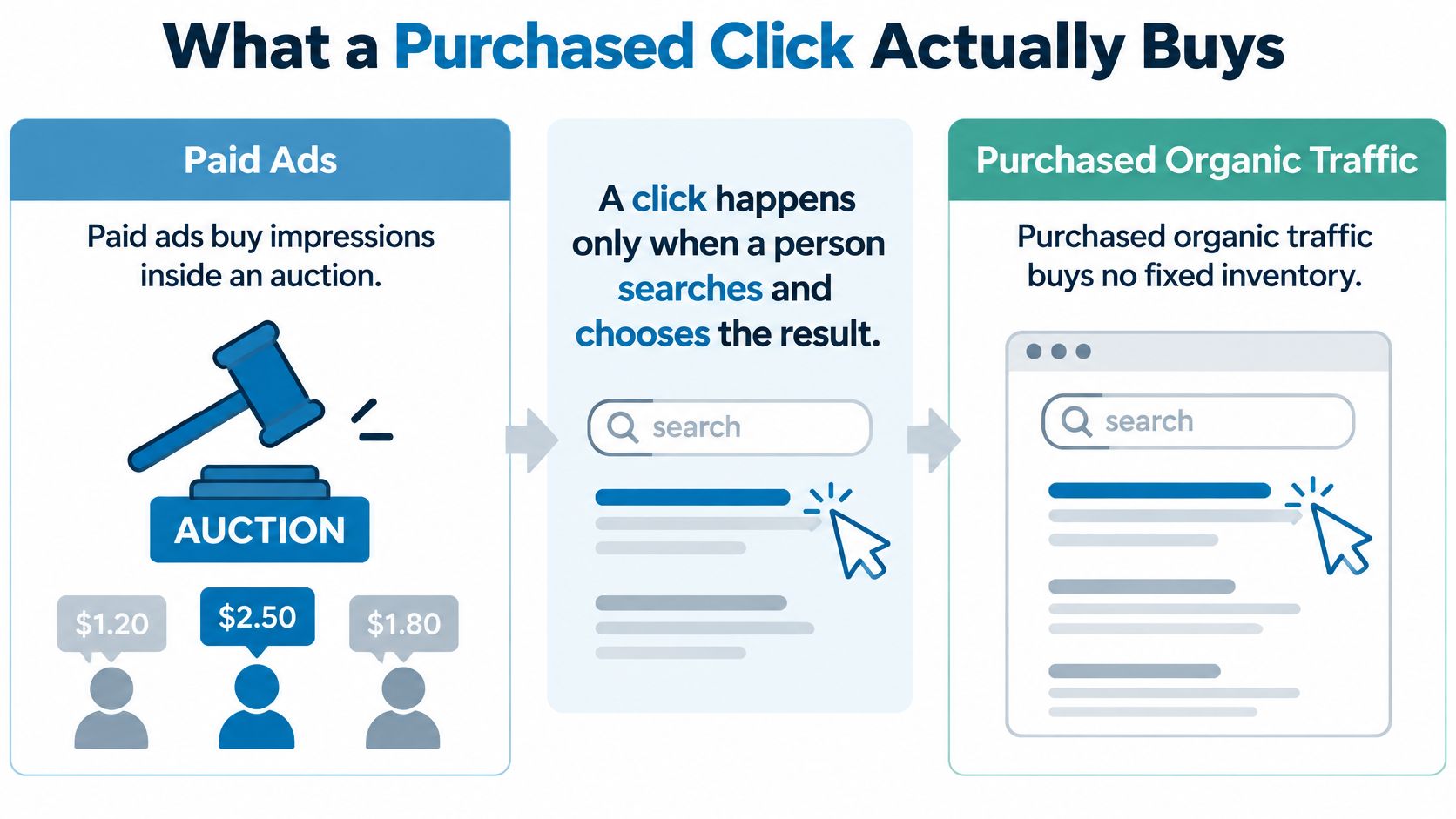
Paid search purchases ad exposure and traffic through an auction-based system. A CTR manipulation service instead coordinates searches and interactions around existing organic results; it doesn't purchase fixed inventory from Google.
Keep these outcomes separate:
- Impressions: Appearances in search results.
- Average position: An aggregated visibility measure.
- Clicks: Recorded interactions with a result.
- Qualified conversions: Relevant purchases, leads, or other defined business outcomes.
The commercial question isn't whether the campaign can produce a recorded click. It's whether spending creates additional customer demand beyond the coordinated activity itself.
Clicks Sessions and Sales Are Different Outcomes
A Search Console click records a user clicking a link to a page in a Google service, according to Google's Performance report documentation. It doesn't establish purchase intent, retention, or independent discovery.
Google's Search Console performance guidance defines CTR as clicks divided by impressions and explains position as an average across impressions. A change in that average isn't proof that purchased activity caused a ranking improvement.
Three layers to compare against the organic baseline
| Layer | Metrics | What it can prove |
|---|---|---|
| Search Console | Clicks, impressions, CTR, average position | Visibility and click activity only, not purchase intent |
| Analytics sessions | Sessions, pages per visit, time on page, bounce rate | Arrival behavior, which participant instructions can shape |
| Downstream outcomes | Conversion rate, assisted revenue, return visits, query diversity, geographic spread | Evidence of business value when validated across systems |
Our traffic and click data appear in customers' preferred tracking tools, including Google Analytics, Google Search Console, and Yandex Webmaster Tools. Visibility in a tracking tool verifies recorded activity, not independent customer motivation.
Separate campaign exposure from audience growth
Compare branded with non-branded queries, targeted with untouched queries, and campaign landing pages with similar untreated pages. Choose comparison pages with similar intent, and record content changes, promotions, and technical fixes that could otherwise explain movement.
Also compare geographic patterns and qualified conversions against the pre-campaign organic baseline. Don't infer demand from longer visits or internal-page navigation alone, because participants can follow instructions that generate those behaviors.
Stopping rule: If targeted clicks rise while qualified conversions, returning visitors, and untouched-query performance stay flat, don't upgrade the subscription.
Require baseline, campaign-period, and post-campaign reporting. A gain that vanishes when activity stops hasn't demonstrated durable ranking improvement, and even a persistent gain needs a credible comparison before you attribute it to the campaign.
What a Campaign Looks Like by Business Type
Say a dental clinic already appears for a city-specific treatment query. Its treatment page has a booking path, the query expresses a service need, and the listing is findable. That's a clearer commercial target than a general article explaining what dentistry involves.
The same intent distinction applies across business models.
Commercial pages need a measurable next action
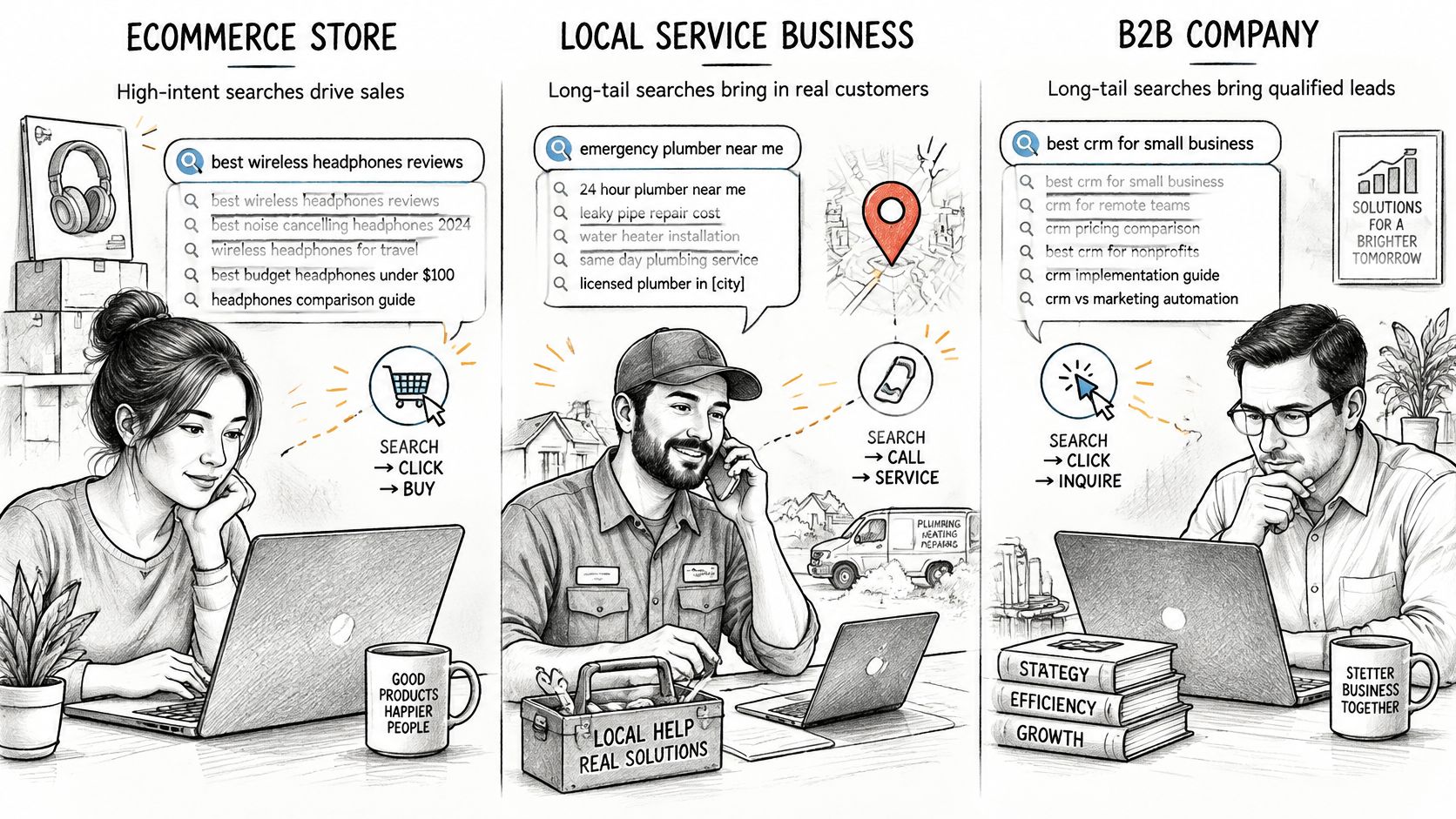
Our targeting emphasizes high-intent, long-tail keywords, including product-review searches and service-in-a-city searches. The landing page should let the searcher complete the task implied by that query.
- Local professional services: A law firm, dental clinic, or medical spa can evaluate qualified inquiries from an existing city-service page.
- Ecommerce and marketplaces: A product page or Amazon, eBay, or Etsy listing needs existing search visibility and a commercially relevant query.
- SaaS businesses: A comparison page needs an appropriate next action, such as a trial or relevant demonstration request.
These are suitability scenarios, not promises that purchased participants will become customers. Marketplace sellers also need to distinguish Google visibility from a marketplace's internal search performance.
Informational traffic needs a tougher spending test
Using aggregated Search Console data for 300,000 keywords, Ahrefs reported that AI Overviews were associated with a 58% lower average CTR for the top-ranking page in December 2025. The finding is observational, not proof that every website experiences the same effect.
An affiliate guide or broad informational blog post is therefore a weaker candidate when Google already provides the answer on the results page. Coordinating extra visits doesn't establish that independent searchers now have a stronger reason to click.
The accompanying video provides additional context for evaluating campaign fit.
Match capacity to commercial opportunities: a starter allocation for a single qualifying local money page, and a larger bundle only when several commercial targets qualify. Avoid spending on informational queries without a credible conversion or audience-building case, and don't confuse this organic service with a Maps ranking campaign.
Growing Clicks Without Buying Them
Pages with existing visibility offer a practical alternative: improve what independent searchers see and what they can accomplish after arrival. Use the same business baseline, but spend on changes to the website rather than coordinated search behavior.
Work through the page before purchasing traffic
Find the impression opportunity. Open Search Console's Performance report and filter for queries with substantial impressions but weak CTR. Inspect the actual results page before deciding that the title is the problem.
Rewrite titles and descriptions. State the service, relevant location, and useful outcome in plain language. An ecommerce page should emphasize the product and buying information rather than forcing a local-service formula onto every title.
Resolve indexing and technical problems. Inspect important URLs, review canonical selections, and fix accidental exclusions or broken destinations. A persuasive listing can't help a page that Google can't reliably access.
Add descriptive internal links. Link from relevant, established pages to commercial pages using anchor text that explains the destination. Don't repeat the same keyword mechanically across unrelated content.
Publish resources worth referencing. Create original pricing explanations, documented case studies, or practical comparison tools. Give other publishers a reason to reference the resource rather than buying links for ranking purposes.
Prioritize commercial long-tail queries. Build pages around services, product attributes, and purchase decisions that your business can satisfy.
Maintain the Google Business Profile separately. Keep business information and customer-facing details accurate while treating Maps work as its own operational task.
Evaluate changes without inventing certainty
Outrank's guide to build sustainable search traffic offers a broader framework for organizing ongoing organic acquisition work. Use it to plan improvements, not as a guarantee that a particular edit will move rankings.
Record what changed and avoid changing everything at once. Review results over several months, allowing for seasonality and other marketing activity, and judge success by qualified outcomes as well as clicks.
No step guarantees a ranking result. These actions give genuine searchers clearer information and a better destination without requiring coordinated searches intended to manufacture ranking signals.
Google Spam Risk and the Go or No-Go Decision
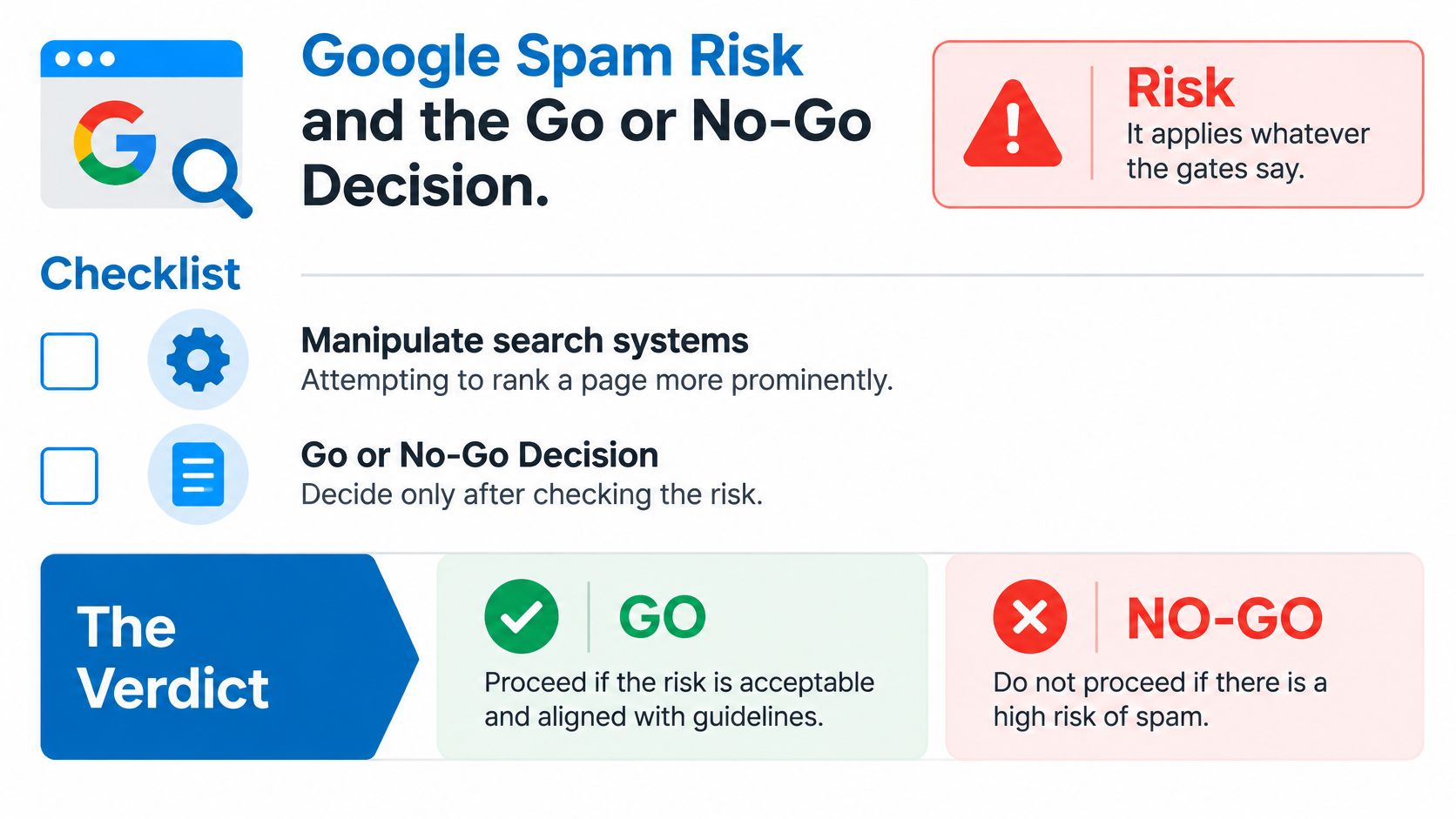
Human participation doesn't remove ranking-manipulation risk. Google's spam policies classify attempts to manipulate search systems into ranking content more prominently as a violation, with enforcement through automated systems or human review and potential outcomes including lower rankings or omission from results.
Our campaigns use real people rather than fake bots, automated software, or proxies. That describes delivery, but it doesn't establish Google approval: the purpose of influencing rankings still matters.
Apply the commercial gates without treating them as permission
The default decision should be don't buy ranking-directed clicks. A buyer considering the service despite that exposure should require every commercial gate to pass:
- Existing visibility: The target already qualifies within the indexed search window.
- Commercial intent: The query supports a local or transactional task rather than an answer already available on the results page.
- Usable capacity: Eligible targets match the subscription allocation.
- Independent measurement: Qualified conversions and untouched-query performance can be tracked.
Passing these gates can reduce wasted spending. It cannot turn a ranking-manipulation purpose into a policy-compliant one.
Limit the commitment and define the exit
If you nevertheless accept the exposure, the only defensible first subscription is the starter Monthly Plan, not a multi-allocation bundle. Treat any refund, guarantee, or extra-run offer as a vendor condition, not evidence that ranking gains will persist.
Technical explanations of Chrome signals and Navboost aren't permission to engineer those signals. A possible ranking mechanism and an acceptable acquisition strategy are different questions.
Stop after the first month if qualified leads and rankings on untouched queries are unchanged. Don't renew solely because the purchased keyword produced more recorded activity, and don't call coordinated engagement new demand without independent evidence.
Scale Rankings offers human CTR campaigns and a free CTR audit to assess existing search visibility and campaign eligibility. Visit Scale Rankings with your target URL, main tracking keyword, and related keywords to review suitability before committing to a subscription, while weighing the Google policy risk against legitimate organic-growth alternatives.