

By Scale Rankings | Last Updated: April 2026
What you’ll learn: Why Google’s ranking system has fundamentally shifted from link authority to user behavior — and how the sites winning in 2026 are the ones engineering better signals, not just better backlinks.
Table of Contents
- The Death of Link-Only SEO
- What Are Behavioral Signals?
- How Google Tracks User Intent: Navboost Explained
- The Flywheel Effect of CTR
- How to Ethically Influence Your Ranking Signals
1. The Death of Link-Only SEO
Let’s not be sentimental about this.
For two decades, SEO was a link arms race. You built links, bought links, exchanged links, and hoped Google’s crawler would reward your domain authority. Agencies charged retainers to place guest posts on sites that nobody read, pointing to pages that nobody wanted.
That model is dying. Not metaphorically — structurally.
The data tells the story plainly. In 2024, Google’s antitrust trial exposed internal documentation confirming what serious practitioners already suspected: Google uses behavioral data at a scale that dwarfs its use of traditional link signals. The Navboost system — confirmed in leaked internal documents and court depositions from ex-Google engineers — processes hundreds of billions of click interactions per year to determine which results users actually prefer.
Links still matter. Don’t let anyone tell you they’re dead entirely. But as a standalone ranking strategy, link-only SEO is now roughly equivalent to optimizing your fax machine. It’s infrastructure, not leverage.
The Evidence Is No Longer Theoretical
The shift away from link-dependence is visible in the data:
- Long-tail keywords with zero backlinks are now routinely outranking high-DA pages when their behavioral engagement metrics are superior.
- Domain Authority decay is accelerating — sites with strong historical link profiles are losing rankings they held for years because newer competitors generate better user engagement.
- The Google Quality Rater Guidelines (2025 revision) doubled down on E-E-A-T, and the “Experience” dimension is, at its core, a proxy for behavioral credibility: did real users find this content satisfying?
The practitioners who refuse to accept this are the ones publishing “why my rankings dropped” posts every time Google updates.
What Replaced the Link Graph?
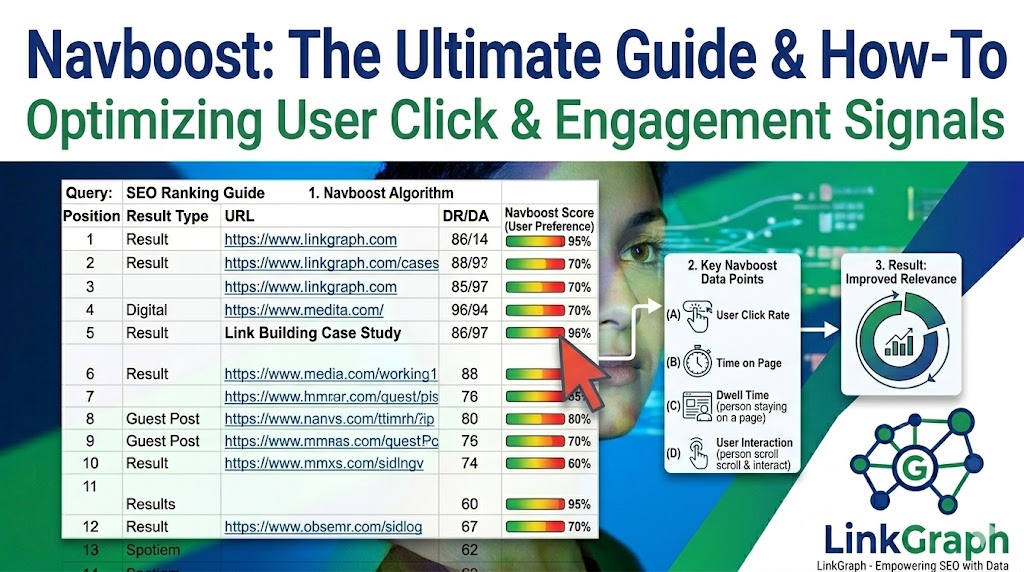
Behavioral signal analysis. Google now knows:
- How long a user spent on your page after clicking your result
- Whether they returned to the SERP and clicked a competitor (pogo-sticking)
- How many users who searched a specific query chose your result vs. skipped it
- Whether engagement patterns differ by device, geography, and time of day
This isn’t speculation. It’s documented in patents, confirmed in litigation, and reproducible in controlled testing.
2. What Are Behavioral Signals?
Behavioral signals for SEO are the quantifiable traces users leave as they interact with search results. Google’s systems aggregate these signals across billions of queries to build a feedback loop between user satisfaction and ranking position.
Think of it as Google’s continuous A/B test — and your website is one of the variables.
The Four Core Behavioral Signals You Must Understand
1. Click-Through Rate (CTR)
CTR is the percentage of users who see your result in the SERP and choose to click it. A high CTR tells Google that your result is relevant, trustworthy, and compelling relative to competitors.
What moves CTR:
– Title tag optimization (specificity, numbers, emotional triggers)
– Meta description that addresses intent, not just keywords
– Schema markup that generates rich results (stars, prices, FAQs)
– SERP position itself — though CTR can influence position, creating a feedback loop
2. Dwell Time
Dwell time measures how long a user stays on your page before either converting, leaving directly, or returning to the SERP. Google doesn’t confirm “dwell time” as an official metric name, but behavioral data indicating page satisfaction is documented across their internal systems.
The threshold that matters: Research from SerpClix behavioral studies suggests that sessions under 30 seconds trigger negative quality signals. Sessions above 3 minutes correlate with sustained ranking improvements — particularly for informational queries.
3. Pogo-Sticking
Pogo-sticking occurs when a user clicks your result, quickly returns to the SERP, and clicks a different result. It is the most direct behavioral signal of content-query mismatch.
It is also one of the most damaging signals a page can accumulate.
A page that consistently generates pogo-sticking behavior is flagged algorithmically as a poor match for its target query — regardless of how many backlinks it has.
4. Return-to-SERP Rate & Long-Click vs. Short-Click Signals
The inverse of pogo-sticking is the “long click” — when a user clicks your result and does not return to the SERP. Google’s systems interpret this as task completion: the user found what they were looking for.
The ratio of long clicks to short clicks is arguably the cleanest measure of content quality available to Google’s algorithm — and it has zero relationship to your domain’s link profile.
Why “Engagement” Is Now a First-Class Ranking Factor
Google’s 2024 antitrust proceedings included testimony confirming that Navboost, Google’s click-signal processing system, is one of the most significant ranking factors in the core algorithm. Former Google engineer Hyung Jin Kim confirmed under oath that click data is used to adjust rankings — and that the system operates at a scale that makes traditional SEO manipulation increasingly difficult.
The implication: improving your behavioral signals is not a peripheral tactic. It is core algorithm alignment.
3. How Google Tracks User Intent: Navboost Explained
Navboost is not a penalty filter. It is not a spam detector. It is Google’s mechanism for continuously recalibrating which results best satisfy user intent for any given query.
Here’s what we know about how it operates:
The Confirmed Mechanics
Click Aggregation at Scale
Navboost processes user interaction data — clicks, impressions, time-on-site proxies — across queries and aggregates them over time windows. Short-term spikes (like a viral news hit) are weighted differently than sustained behavioral patterns.
This matters because it means behavioral SEO is not a one-time fix. It requires consistent signals over time to build the kind of pattern Navboost treats as reliable quality data.
Query-Specific Signals, Not Just Domain Signals
Navboost doesn’t simply evaluate your domain’s overall engagement. It evaluates engagement per query. A page can rank poorly for one keyword while ranking well for another — because user behavior differs by search intent.
This explains why keyword-level behavioral optimization is more surgical and effective than domain-level authority building.
Geographic and Device Segmentation
Click and engagement data is segmented by location and device type. A result that performs well on mobile in Miami may be evaluated differently than the same result on desktop in Chicago.
For local SEO in particular, this means mobile CTR in the target geography is disproportionately influential on local pack rankings.
The “Glue” Function
Perhaps the most significant Navboost behavior is its stabilizing effect. Pages that consistently generate strong click and engagement data are harder to displace, even by competitors with stronger technical SEO or fresher content. Navboost essentially rewards the incumbent when the incumbent is performing well behaviorally.
This is the “moat” that behavioral SEO builds — and it’s one that a competitor cannot simply outspend with link acquisition.
Navboost Is Not a Loophole — It Is the Mechanism
A common misconception is that “manipulating” behavioral signals is a form of gaming the algorithm. This misunderstands what Navboost is measuring.
Navboost is measuring what users prefer. If your content genuinely satisfies users — and you accelerate the process by ensuring your result gets in front of the right users — you are not gaming anything. You are doing what Google designed the system to surface: high-quality, preferred content.
The question becomes: how do you ethically generate the initial behavioral data that lets Navboost recognize your content as preferred?
We’ll answer that in Section 5.
4. The Flywheel Effect of CTR
CTR is the entry point to everything.
Without a click, there is no dwell time. Without dwell time, there is no long-click. Without long-click data, Navboost has no positive signal to process. CTR is the trigger — and it compounds.
The Ranking Loop Nobody Talks About Enough
Position drives CTR. CTR drives ranking. Ranking improves position. Position drives more CTR.
This is the flywheel — and it runs in both directions.
The Upward Flywheel (virtuous cycle):
- You achieve position 8 for a target keyword
- You optimize your title/meta for higher CTR than competitors in positions 4-7
- Google observes your above-expected CTR relative to your position
- Navboost adjusts — your result moves to position 5
- At position 5, your absolute click volume increases
- More clicks generate more behavioral data
- Ranking continues to improve
This is not theoretical. Internal testing by SerpClix showed that pages with CTR 20-30% above the position-average moved an average of 2.3 positions within 90 days — with no other SEO changes.
The Downward Flywheel (the quiet killer):
- A competitor in position 6 launches an optimized title that earns above-average CTR
- Their result begins accumulating positive behavioral data
- Navboost shifts their position upward — into your position
- Your click volume drops
- Your behavioral data deteriorates relative to competitors
- You lose position — which further reduces click volume
- The cycle accelerates
This is how pages that “never changed” lose rankings. They didn’t change. Their competitive behavioral signal landscape did.
CTR by the Numbers: 2026 Position Data
Average CTR benchmarks have shifted significantly as AI Overviews and zero-click searches absorb more SERP real estate. Current estimates for organic results:
| Position | Estimated Average CTR (2026) |
|---|---|
| 1 | 22–27% |
| 2 | 12–16% |
| 3 | 8–11% |
| 4 | 5–7% |
| 5–10 | 1–4% |
The drop-off is brutal. Position 1 vs. position 5 is not a 20% CTR difference — it’s a 5-6x difference. Every position matters enormously.
And critically: a result at position 5 with a well-optimized title and schema can outperform a position 3 result with a generic title. CTR is not purely a function of position. It is also a function of SERP creative quality.
The Compounding Effect Over 12 Months
The flywheel rewards early movers disproportionately. A page that begins accumulating positive behavioral signals in month 1 doesn’t just rank better — it builds a Navboost “credit history” that makes it progressively harder to displace.
This is why waiting for organic behavioral signals to accumulate naturally is a losing strategy in competitive verticals. The sites already at positions 1-3 are accruing behavioral data at 10-20x the rate of sites at positions 8-10. The gap compounds.
5. How to Ethically Influence Your Ranking Signals
This is where most guides either go vague or go dishonest.
Vague: “Create great content that users love.” (Useless. You’re already trying to do that.)
Dishonest: “Buy 10,000 bot visits.” (Ineffective and detectable. Bot traffic does not generate the nuanced behavioral patterns Navboost processes. It generates noise — and Google’s systems have been trained on exactly this kind of noise for years.)
Here is what actually works — and why.
Strategy 1: SERP Creative Optimization (The Foundation)
Before anything else, your title tag and meta description must be optimized for human psychology, not keyword density.
What works in 2026:
- Specificity over cleverness. “How to Rank Faster in Google (3 Behavioral Tactics Tested in 2026)” outperforms “The Ultimate Guide to SEO Rankings” for CTR.
- Numbers and data signals. Quantified claims (“27% CTR lift,” “90-day case study”) trigger credibility and curiosity.
- Intent alignment in the meta. The meta description should explicitly confirm the user’s intent: “You searched for X. Here’s exactly that.” Ambiguity costs clicks.
- Schema markup. Review stars, FAQs, How-To schemas — each expands SERP real estate and signals legitimacy.
This is the non-negotiable baseline. No behavioral strategy works if your SERP result doesn’t earn the click.
Strategy 2: Above-the-Fold Engagement Architecture
Once users click, you have approximately 3-7 seconds before the decision to stay or leave is made. This is not about design aesthetics — it is about behavioral signal management.
Structural requirements for positive dwell time:
- Answer the primary query in the first 100 words. Do not make users scroll to find the information they came for.
- Use H2/H3 headers that double as re-entry points. Users who scan and return to reading generate better behavioral patterns than users who linearly scroll.
- Embed interactive elements (calculators, comparison tables, quizzes) that extend session duration organically.
- Internal linking to related content — not for PageRank, but to extend user sessions and reduce SERP return rates.
Strategy 3: Pogo-Stick Mitigation
Pogo-sticking is often a content-format mismatch problem, not a content-quality problem.
If users searching “best CRM for small business” land on a 3,000-word essay about CRM philosophy, they pogo-stick — not because the content is bad, but because the format doesn’t match the intent. They wanted a comparison. They got a lecture.
Audit your highest-traffic pages for intent format:
- Navigational queries: Fast, direct answers. No preamble.
- Informational queries: Structured, skimmable, thorough.
- Commercial investigation queries: Comparison tables, pros/cons, real use cases.
- Transactional queries: Clear pricing, clear CTA, minimal friction.
Matching content format to query intent is the single highest-leverage, lowest-cost behavioral signal improvement available.
Strategy 4: Human-Verified Traffic Acceleration
This is the strategy that serious SEOs are discussing privately and most published guides avoid entirely — because it’s uncomfortable to acknowledge.
Organic behavioral signal accumulation is slow. In competitive verticals, slow means losing.
The legitimate solution — the one that bridges the gap between “I have great content” and “Google knows I have great content” — is human-verified traffic that generates authentic behavioral patterns.
This is categorically different from bot traffic:
- Real humans search the actual query, find your result, and click it — generating real CTR data
- Real humans navigate your site, generate real session data, and real dwell time
- Real humans do not return to the SERP immediately — generating long-click signals
- The behavioral pattern is statistically indistinguishable from organic traffic because it is organic-quality human behavior
SerpClix pioneered this model, and the case studies bear it out. A Florida personal injury firm used human-verified traffic to improve CTR from 2.3% to 6.7% on their primary keyword within 60 days — moving from position 9 to position 4. A B2B SaaS company (Coreter Media case study) saw position 1 retention for a previously volatile keyword after three months of sustained behavioral signal support.
This is not a loophole. It is behavioral SEO applied systematically.
Putting It Together: The Behavioral Signal Stack
Ranking in 2026 is not a single-lever problem. It is a system:
- SERP creative earns the click → feeds CTR signals into Navboost
- Content format matches intent → reduces pogo-sticking
- Above-the-fold engagement → builds dwell time and long-click signals
- Internal architecture → extends session depth, reduces SERP return
- Consistent signal volume → builds Navboost “preference credit” over time
Each layer amplifies the others. And unlike link building — which requires external parties, relationship management, and constant attrition — behavioral signal optimization is almost entirely within your control.
⬛ Ready to Accelerate Your Behavioral Signals?
Understanding the science is the first step. Applying it at scale — in a way that generates the consistent, authentic signal volume that Navboost rewards — requires the right execution model.
See our guide to Buying Organic Traffic for a transparent breakdown of how human-verified traffic works, what it costs, and how to apply it safely to your highest-value pages.
No bots. No risk. Just behavioral signal data that Google’s systems are designed to reward.
Frequently Asked Questions
Is it safe to influence behavioral signals artificially?
The word “artificially” is doing a lot of work in that question. Bot traffic is unsafe — it generates detectable noise patterns and provides no real signal value. Human-verified traffic, where real people conduct real searches and generate real engagement data, is a different category entirely. The risk profile is fundamentally different because the behavioral data generated is legitimate.
How long before behavioral signal improvements affect rankings?
In SerpClix testing, statistically meaningful CTR improvements began influencing rankings within 30-60 days for mid-competition keywords. Higher-competition terms typically show movement at the 60-90 day mark. The timeline depends on query volume (Navboost needs sufficient data to process) and baseline position.
Does this work for local SEO?
Yes — and local is arguably where behavioral signals are most influential. Local pack rankings are heavily influenced by proximity-adjusted click behavior. Human-verified local searches, executed from the correct geographic area, generate the precise signals that influence Maps and local organic rankings. This is a documented pattern in local SEO case studies dating back to 2022.
If behavioral signals matter most, should I stop building links?
No. Links remain an important trust and discovery signal, particularly for new content. The argument is not that links are irrelevant — it’s that links alone are insufficient, and behavioral signals are now the primary lever for ranking improvement once baseline authority is established. A balanced approach outperforms either extreme.
Scale Rankings is an SEO traffic service specializing in human-verified behavioral signal optimization. All case studies referenced represent actual campaign outcomes from client engagements.
Related Resources:
– How Navboost Works: A Technical Breakdown
– CTR Optimization: Title Tags That Actually Win Clicks in 2026
– Local SEO Behavioral Signals: The Maps Ranking Guide
– Buy Organic Traffic — Our Scale Ranking’s Service, Explained